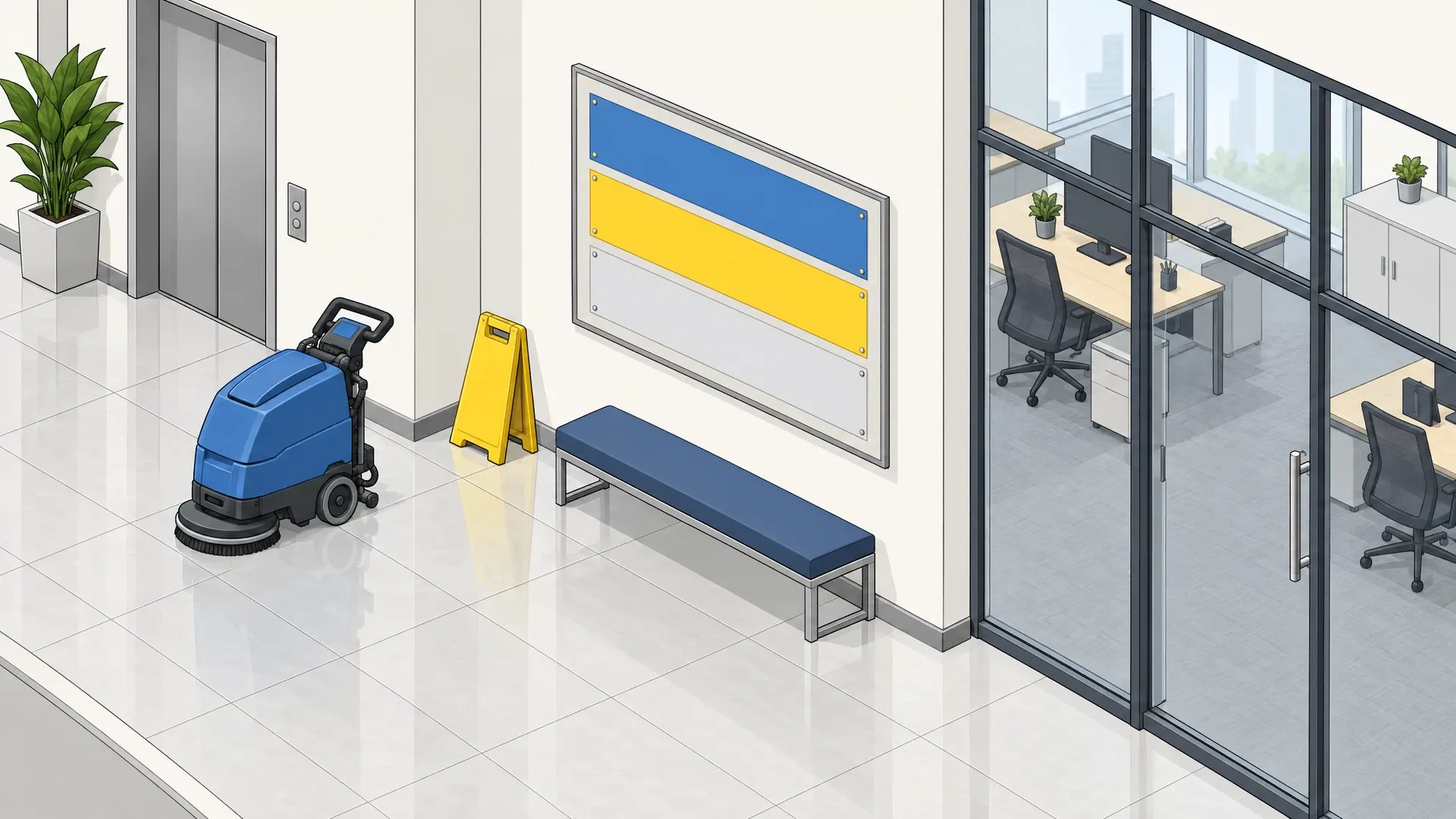
A maintenance schedule is a specification document. It says who cleans what, how often, with which product, and what gets recorded. Without it, the floor is maintained by habit, and habit varies with staff turnover.
This guide gives a structure you can adapt. The frequencies are starting points; the inspection is what sets the real interval.
Build the schedule from zones, not rooms
Two rooms of the same size can have completely different maintenance needs. A meeting room with ten people a day and a public corridor with ten people a minute are not the same asset.
Divide the building into zones:
- Entrance zones: the first few metres inside every external door, where grit and water arrive.
- Circulation: corridors, stairs and lift lobbies.
- Work areas: offices, desks, back-of-house.
- Wet areas: kitchens, bathrooms, cleaners’ cupboards.
- Special areas: server rooms, plant, storage.
Write the floor type and finish next to each zone. That table becomes the cleaning specification.
The four frequencies
| Frequency | Task | Purpose |
|---|---|---|
| Daily | Dry sweep or vacuum; spot mop spills | Remove grit before it abrades the surface |
| Weekly | Damp mop with the specified dilution; detail edges | Remove film and soil that sweeping misses |
| Quarterly | Machine scrub or buff; check drains and thresholds | Restore the surface and catch detail failures |
| Annually | Condition survey; repair list; review products | Turn replacement into a budget decision |
For carpet, replace damp-mopping with vacuuming and periodic extraction. For hard surfaces, add a neutral cleaner and a rinse step; detergent residue attracts soil and dulls the finish.
Match the method to the floor
| Floor | Routine | Avoid |
|---|---|---|
| Rigid core LVT | Damp mop, pH-neutral cleaner, dry after | Steam, standing water, abrasive pads |
| Sheet vinyl | Damp mop, machine scrub at low speed | Flooding seams, solvent cleaners |
| Polished concrete | Dust mop, neutral cleaner, occasional burnish | Acid cleaners on a reactive surface |
| Porcelain tile | Wet mop, neutral or alkaline cleaner | Acid on cementitious grout |
| Quarry tile | Deck scrub, degreaser, rinse | Leaving grease film in the joints |
| Epoxy resin | Neutral cleaner, soft pad | Solvents and sharp scrapers |
| Carpet tile | Vacuum, spot clean, extraction | Over-wetting the backing |
| Timber | Dry mop, damp mop with timber cleaner | Steam, standing water, wax build-up |
Always confirm against the manufacturer’s written instructions. Where the two conflict, the manufacturer’s instructions and the warranty conditions win.
Chemicals, dilution and records
Most damage from cleaning comes from concentration, not from the chemical itself. Over-strength cleaner leaves residue that attracts soil and can dull or discolour a finish. Under-strength cleaner leaves grease in the joints.
Keep a one-page chemical sheet: product, dilution, dwell time, rinse requirement and the floors it is approved for. Store it with the COSHH or safety data sheets, and use the same list in every cleaning contract.
Record the basics: date, zone, task, product, and any damage found. A simple log is enough. It supports a warranty claim and shows a pattern before a floor fails.
Matting is maintenance
A mat at every entrance is cheaper than replacing an entrance floor. Use a scraper mat outside and an absorbent mat inside, sized so a person takes several steps on it. Clean the mats; a saturated mat spreads water rather than removing it.
Matting also reduces slip risk in wet weather, which matters more than the finish when someone is carrying a box.
Inspect, then adjust
Once a year, walk the building with the schedule and a camera. Record condition by zone, photograph the same spots each year, and list repairs with an estimated cost. Then adjust the frequencies: if the entrance zone is worn but the back office is untouched, the schedule is doing its job and the specification for the entrance needs attention.
The annual inspection is also the moment to check spare stock, batch references and the original datasheets. A floor with a record is easier to repair, easier to budget and easier to hand over.
Where to go next
If you are choosing the floor, start with commercial flooring types and durability ratings explained. For turnovers, use the scheduling guide. For a portfolio-wide plan, the ten-year replacement budget shows how to turn inspection notes into a capital forecast.