
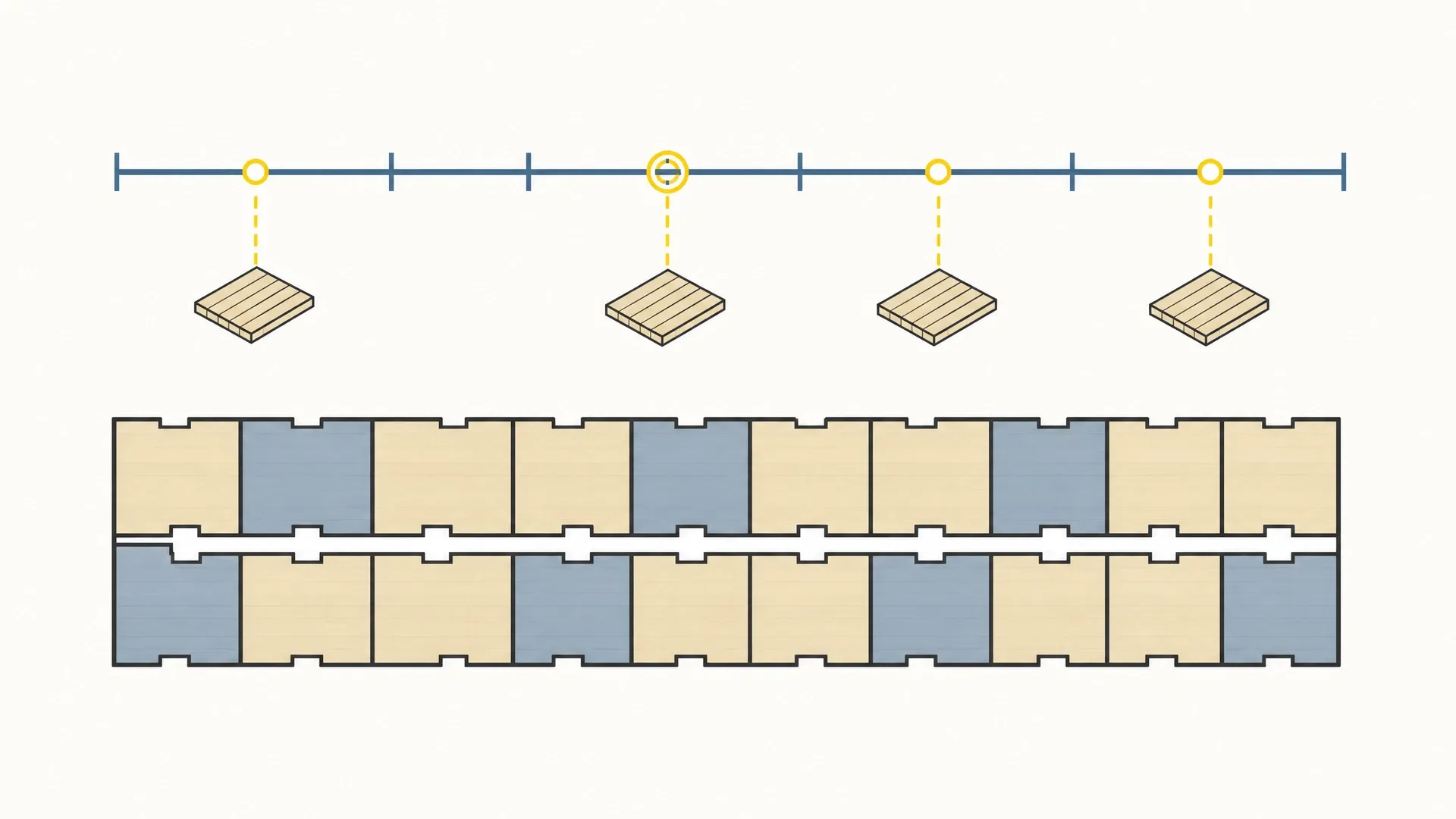
Flooring is usually replaced one unit at a time, in a hurry, after a tenant leaves, and out of whatever cash is available that month. That is why it feels expensive: not because floors cost more than they should, but because nothing was set aside before the work became urgent. A ten-year capital plan fixes the timing problem without needing prices you do not have yet. It uses quantities and dates you can measure, plus one cost figure you supply. Everything else is arithmetic and a yearly review.
Start with the inventory
The plan needs a list of what you own before it needs a bank balance. One row per floor type per unit is the right level of detail: a unit with carpet in two bedrooms and sheet vinyl in the kitchen is two rows, because the two surfaces wear differently and will be replaced at different times.
Each row needs six facts. The unit reference, so the row can be found again. The floor area in sq ft, measured from plans or on site and limited to the area that would actually be replaced. The floor type, described in plain terms: tufted carpet, rigid-core plank, cushioned sheet vinyl, homogeneous sheet, laminate, ceramic tile, sealed concrete. The install date, even if approximate. A condition grade. And a short note on traffic, because a floor beside a shared entrance does not age like one in a second bedroom.
Condition grading is what makes the plan honest. Use four steps and define them in writing so every unit is judged the same way:
- Grade A: as new. No visible wear, no lifting, no repairs outstanding.
- Grade B: serviceable. Surface wear in traffic lanes, colour loss, maybe a small repair, but the floor is intact and cleanable.
- Grade C: worn. Replacement is likely within the next few turnovers, and repairs are becoming frequent.
- Grade D: failing. Trip risk, water damage, delamination or a floor that cannot be brought back to a lettable standard. Replace at the next void.
Grade, not age, drives the plan. A well-maintained floor in a quiet unit will outlast a neglected one in a busy one, and an install date taken from a previous owner’s paperwork is often wrong.
Turn condition and traffic into a service-life band
The next step is to translate each row into an expected service life. Work in bands rather than exact years, and calibrate the bands against your own replacement history. Where there is no history, start from the manufacturer’s stated warranty period, then adjust down for heavier traffic, a thinner wear layer or a weak maintenance regime. The result is an estimate you can defend, not a prediction.
| Floor type | Light traffic | Moderate traffic | Heavy traffic |
|---|---|---|---|
| Tufted or loop carpet | Medium | Short | Short |
| Cushioned sheet vinyl | Long | Medium | Short |
| Homogeneous commercial sheet | Long | Long | Medium |
| Rigid-core vinyl plank | Long | Medium | Medium |
| Laminate | Medium | Short | Short |
| Ceramic or porcelain tile | Long | Long | Long |
| Sealed or polished concrete | Long | Long | Long |
| Engineered timber | Long | Medium | Short |
Read the bands as positions within your own range, not as fixed numbers. Long means the top of the range you have observed in comparable units; short means the bottom. Traffic is assessed by room and building, not by unit type: bedrooms and low-occupancy offices are light, living areas and shared hallways in small blocks are moderate, and shared entrances, kitchens, retail floors and food service are heavy. The ratings behind those bands are covered in the guide to durability ratings.
Two corrections are worth applying before the band is final. Maintenance moves a floor up or down a band over its life, so a unit with no cleaning schedule should be assumed at the lower end. And a floor that fails early usually fails for a reason found at installation: a subfloor that was not flat, a moisture problem, or the wrong product in a wet room. Fix the cause in the plan’s notes, or the replacement will fail on the same schedule.
Convert the band into a yearly provision
Now the arithmetic. Four variables, one formula. Let A be the floor area for that row in sq ft, C the replacement cost per sq ft, N the number of units with that floor type, and L the service life in years taken from the band.
Annual provision = (A × C × N) ÷ L
C is the only figure you have to supply, and it should be a supply-and-fit number covering removal, disposal, substrate preparation, materials, adhesive or underlay and labour. Use a recent quote, or divide a past invoice by the area it covered. Do not use a material-only figure; the labour and prep are the parts that move.
One unit with 600 sq ft of plank, at your cost per sq ft C, has a replacement cost of 600 × C. Spread across a ten-year life, the annual provision is 600 × C ÷ 10, or 60 × C. Ten such units contribute 600 × C a year. Set the life to five years in a heavy-traffic unit and the figure doubles to 120 × C, which is the point of grading traffic honestly.
Add the rows together and you have a yearly contribution for the whole portfolio. Then add contingency. Size it by policy rather than by habit: enough to cover one unplanned replacement in the portfolio in a given year, plus the gap between your cost figure and the eventual invoice. Hold the total in a separate account, ring-fenced for flooring. A reserve that drifts into general cash is not a reserve.
The plan on one page
The working document is a table, not a model. One row per floor type per unit, with a total at the bottom. Fill it in from the inventory and reprice the cost column once a year.
| Unit | Floor type | Area (sq ft) | Installed | Grade | Life (years) | Cost per sq ft | Provision per year |
|---|---|---|---|---|---|---|---|
| Portfolio total |
Two habits keep it useful. Record the invoice against the row when work is done, so the cost column is corrected with evidence rather than memory. And keep the area column in sq ft throughout, because mixing units produces a number that looks plausible and is wrong.
Batch the work and keep stock
Rows that fall due in the same year are cheaper to do together than one at a time: one material order, one mobilisation, one set of disposal arrangements. Group by floor type first, then by building, then by condition, and schedule the work into void periods rather than around sitting tenants. The sequencing options are set out in scheduling flooring between tenants.
Do not replace a grade B floor because it is the same age as a grade D one. Age is a proxy for condition, not a substitute. A sound floor that looks tired can often be kept with a deep clean, new transition strips and fresh skirting, which is maintenance spending rather than capital.
Spare stock belongs in the plan. When a run is installed, keep a labelled quantity of the same production run for repairs at the tail end of its life, stored flat and dry, and note where it is held. When a product is discontinued, bring that row’s replacement forward rather than patching with a mismatch, because a visibly patched floor affects the letting more than an early replacement does.
Check the accounting, then review every year
The accounting caveat
A sinking-fund provision is a management reserve. It is not by itself a tax deduction, and whether flooring spend is treated as a repair or as a capital improvement depends on the work done and on the rules where you own the property. Replacement of a whole floor is usually capital; a repair to part of one may not be. Ask an accountant to confirm the treatment before the reserve is set up, and keep invoices and scope notes that show what was actually done.
The annual review
Review the plan once a year on a fixed date, alongside insurance or rent reviews so it is not forgotten. Re-grade every unit, replace estimated costs with the past year’s invoices, roll the ten-year window forward by one year, and check whether the batching still makes sense. Flag any unit that has dropped two grades in a year: that is a signal about the floor, the tenant or the installation, and it deserves a look rather than a bigger budget line.
Maintenance spending belongs in the same review. A cleaning and inspection routine that keeps floors inside warranty will push replacement dates out, and the maintenance schedule guide sets out the routine. The saving is not in the cleaning budget; it is in the years added to the replacement cycle.
What to do next
Start with one building. Measure the floor areas, list the floor types and grade every unit using the four-step scale, then put the rows into the blank table above. Use the rental unit flooring guide to confirm which floor type belongs in each room, and the LVP versus sheet vinyl comparison for the wet-room split that settles several rows at once. Then obtain one real supply-and-fit cost per sq ft to calibrate C, either from a contractor quote or from your own past invoices, and request a consultation if you want the specification checked before it enters the plan.