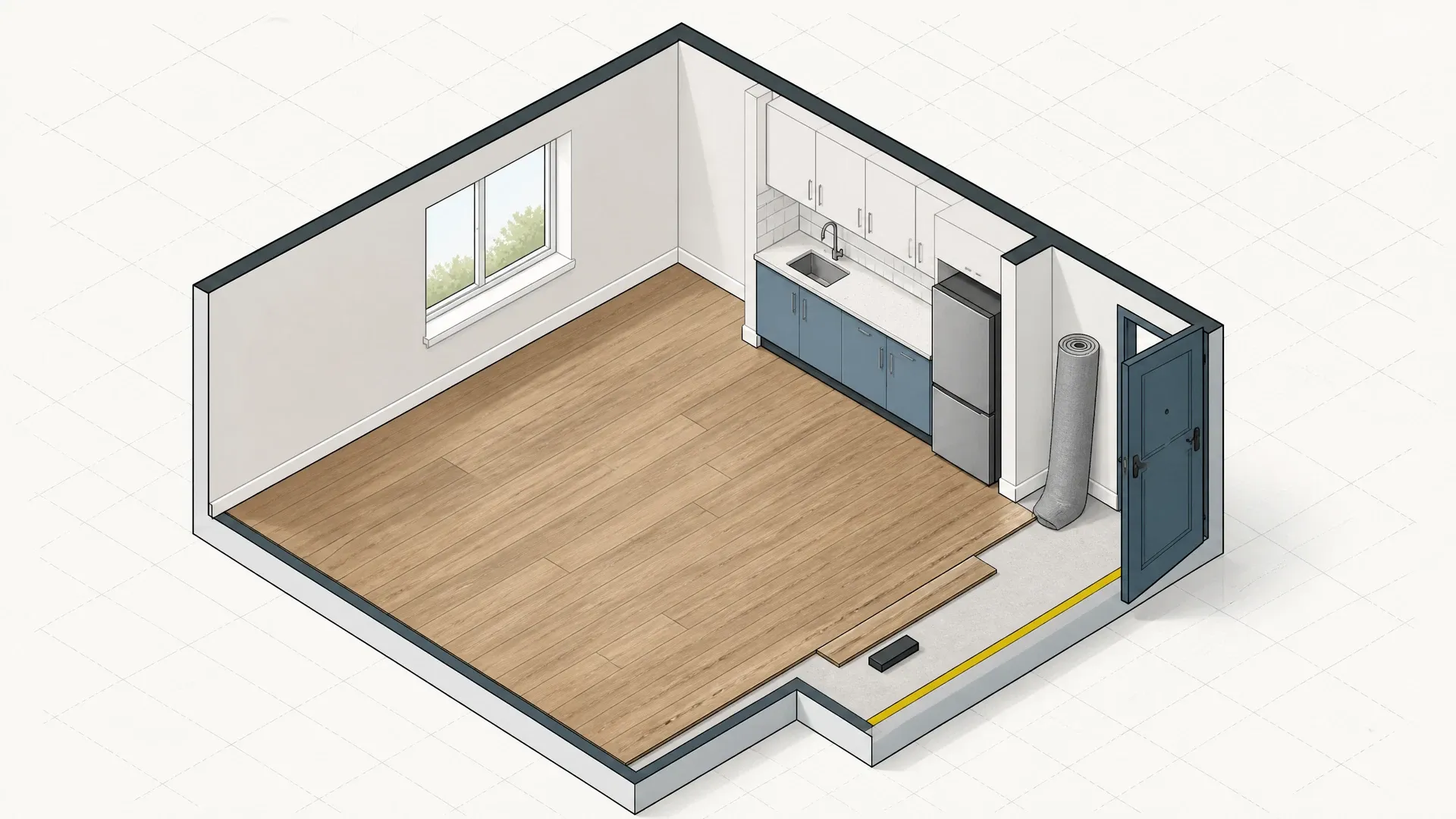
Rental flooring has two audiences. The tenant sees the colour and the feel. The owner sees the repair bill three years later. A specification that satisfies only one of them is not finished.
The sensible approach is to choose by room, not by unit. Kitchens and bathrooms have water. Hallways have grit. Bedrooms have furniture dragged across them. Each of those is a different floor problem, and treating the whole unit as one product usually means over-specifying one room and under-specifying another.
Start with the risk map
Walk the unit and mark the wet zones, the entry route and the places where furniture moves. Kitchens, bathrooms, utility cupboards and bin stores are wet zones. The front door to the kitchen is the grit route. Living rooms and bedrooms are dry but not low-traffic.
A simple risk map is enough:
- Wet zones: sheet vinyl, tile or a waterproof rigid core with sealed joints.
- Grit route: a higher wear layer, a mat at the door and a cleanable finish.
- Dry rooms: plank, carpet tile or carpet, chosen on acoustics and budget.
- Stairs: carpet or a securely fixed plank with a compliant nosing.
Plank, sheet or carpet
Rigid core vinyl plank is the common choice for living areas. It is repairable, familiar to tenants and can be lifted and re-laid in places. Its weakness is water at the seams and at the perimeter, and its tolerance of an uneven subfloor is limited.
Sheet vinyl is the lower-risk choice for wet rooms. With heat-welded seams and a coved skirting it gives a continuous surface that a mop can cross without finding a joint. It shows subfloor imperfections more readily, so preparation matters.
Carpet still earns its place in bedrooms and on stairs, where impact sound and comfort matter. Use carpet tile if you want to swap a damaged square, or a broadloom with a spare offcut. Avoid carpet in any room with a water supply.
Detail B · Turnover floor checklist
- Record
- Photograph the existing floor and note the product, batch and install date.
- Test
- Slab moisture and flatness in each room, not just the hallway.
- Repair
- Fill cracks, grind high spots, prime the substrate as specified.
- Acclimate
- Let the material sit in the unit for the manufacturer’s minimum period.
- Install
- Leave expansion gaps, fit thresholds and seal wet-area perimeters.
- Handover
- Clean, photograph, and give the tenant the cleaning instructions.
The two items that most often get skipped are the moisture test and the photographs. Both are cheap now and expensive later.
What to write into the tenancy pack
A floor fails because of cleaning as often as because of traffic. Steam mops and excess water are the usual culprits in vinyl and timber. Put the cleaning method in the tenancy pack, in plain language, and repeat it at check-in.
State the allowed products, the dilution if relevant, and what not to use. “Do not steam mop” is clearer than “follow the manufacturer’s instructions”, which nobody looks up. If the building has a cleaner, give them the same note.
Repair stock and records
Keep a box of plank from the same batch and a square of sheet vinyl for each colour used in the portfolio. Record where each product was installed, with the room and the date. When a repair is needed, the stock and the record turn a two-day job into a two-hour job.
This is also the basis of a replacement budget. A floor with a known install date and a condition score is an asset with a plan. A floor with no record is a surprise.
Where to go next
Compare the two main options in LVP versus sheet vinyl for rental turnovers, then build the numbers with a ten-year replacement budget. For the operational sequence, read scheduling flooring work between tenants. If the unit is part of a larger building, the commercial flooring types page covers shared areas and mixed-use floors.