
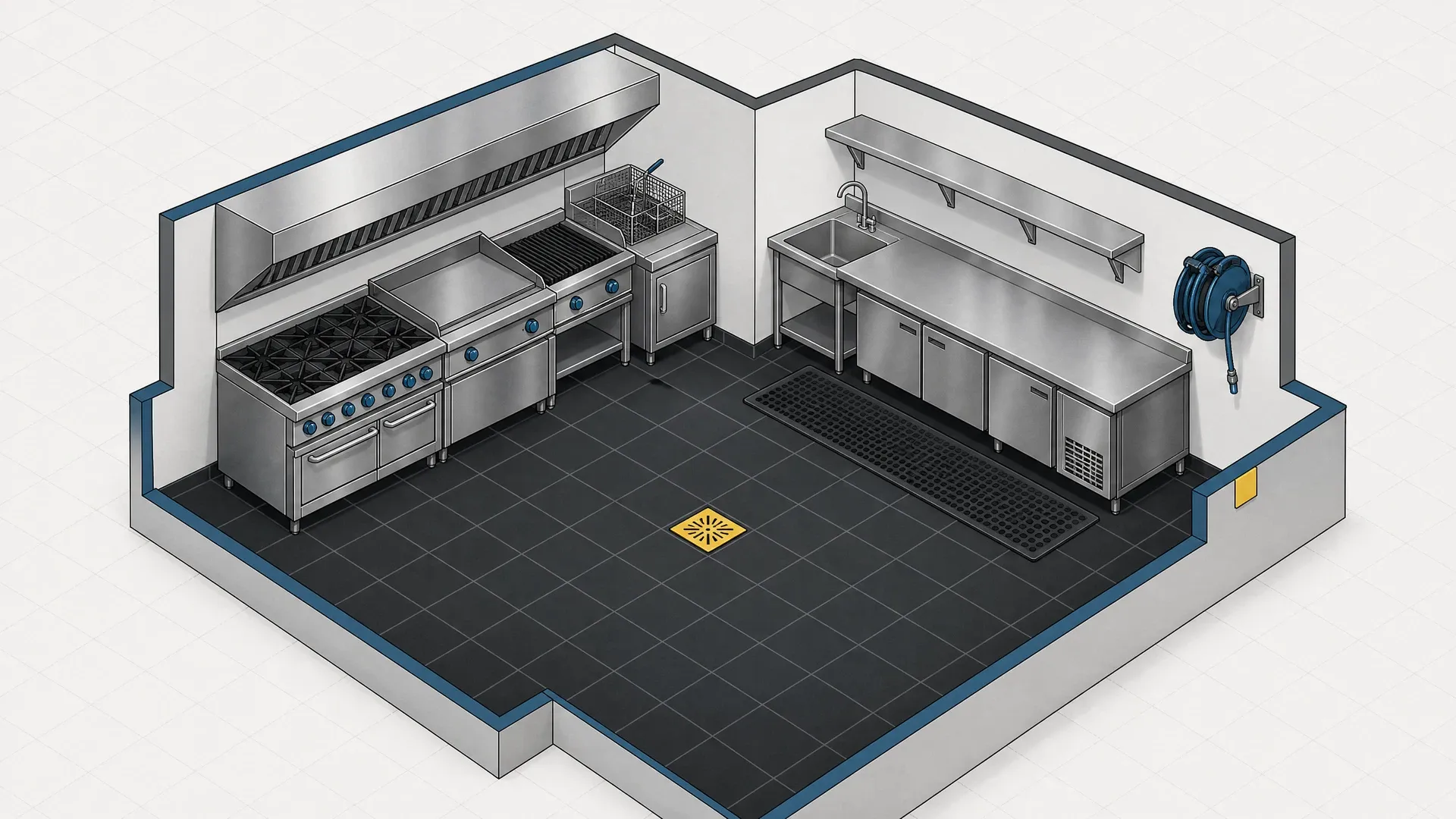
A restaurant kitchen floor is wet, hot, greasy and impact-loaded at the same time, then cleaned with chemicals strong enough to attack the floor itself. Most failures do not start with the wrong product. They start with details left to the installer: a drain set high, a movement joint grouted solid, a cove formed with silicone, a floor opened before the adhesive cured. This guide covers what fails, how the four common build-ups compare, and what to put on the drawing so the floor can be priced and installed without interpretation.
What fails first
Failures cluster around five conditions. Specify for the worst, not the average day.
Grease and hot oil
Oil does not stay on the surface. It migrates into grout, behind a failed cove, under a lifted seam and into cut edges. Once it is under a resilient floor it keeps spreading and the adhesive lets go. Hot oil also shocks the surface: a splash at frying temperature can stain, soften or lift a tile or vinyl surface. A cook-line floor needs a surface that resists oil absorption and a joint detail that gives oil nowhere to sit.
Thermal shock from wash-down
Kitchens are washed with hot water and sometimes steam, then rinsed cold. Tile, adhesive, grout and substrate expand at different rates. Repeated cycles crack grout, loosen tiles and open the floor-to-wall joint. Resin systems survive if the system is specified for the temperature range and the substrate is sound; a thin coating over a weak screed will blister. Sheet vinyl copes with water but not with steam directed at a seam.
Dropped implements and point loads
A pan dropped edge-first concentrates load on a small area. Quarry tile chips at the edge; porcelain can crack; vinyl can cut through the wear layer; resin can gouge. Impact resistance is a property of the whole build-up, not just the surface, so a hard tile on a hollow substrate fails sooner than the same tile on a fully bonded screed.
Cleaning chemicals
Degreasers, sanitisers, acids and chlorine are part of the process. Cementitious grout erodes under repeated caustic cleaning; sealants harden and pull away; some resin surfaces chalk or yellow. Ask for the cleaning chemical list before the floor is chosen and check the manufacturer’s resistance data against it. A floor that cannot be cleaned with the kitchen’s own chemicals is the wrong floor.
Water at the edges
Water finds the perimeter, the drain and every penetration. A failed seal at a cove or drain flange lets water into the screed, where it stays. The visible floor looks sound while the substrate softens underneath. Details, not the field of the floor, decide whether this happens.
The build-ups compared
Four families cover most commercial kitchens. Each has a place; none is universal.
| System | Best use in a kitchen | Weak point | Service life expectation |
|---|---|---|---|
| Quarry tile | Cook lines, wash-up, areas with hot oil and heavy impact | Grout joints absorb oil; edges chip; substrate movement cracks tiles | Long, with grout renewal and tile replacement |
| Porcelain tile | General kitchen floors, wet rooms, areas needing a hard cleanable surface | Polished faces are slippery when wet; large formats need a very flat substrate; grout remains a joint | Long, joint-dependent |
| Epoxy or PU resin screed | Seamless areas with coving, wash-down and chemical exposure | Moisture-sensitive during application; can blister or gouge; repairs are visible | Medium to long, recoating dependent |
| Sheet vinyl or rubber | Back-of-house, staff areas, dry storage, light prep | Hot oil and sharp impact cut or stain; seams and adhesive fail first | Medium, wear-layer dependent |
Service life is qualitative because substrate, installation, cleaning and traffic decide it, not the product name.
Slip resistance for wet and oily areas
Slip is measured, not guessed. The DIN 51130 ramp test walks a person up and down an inclined surface coated with oil and assigns an R value. R11 and R12 are commonly specified where grease and water meet the floor; R13 is reserved for the most demanding wet and oily conditions. The test measures the product as supplied. It does not account for a grease film left by poor cleaning, worn texture or grout eroded below the tile face.
DIN 51097 covers barefoot wet areas, such as staff showers and changing rooms, and uses A, B and C classes. It is not a substitute for DIN 51130 in a working kitchen. In the US, ASTM D2047 measures dry static coefficient of friction; useful on level dry surfaces, but it does not tell you how a floor behaves under oil. The HSE and OSHA both publish guidance on managing slip risk at work.
Specify by zone. A dry store, a prep area, a cook line and a wash-up area do not carry the same risk. Put the required class against each zone on the drawing, then check the delivered product’s test report matches. A textured surface that is hard to clean can be a worse slip risk than a smoother one kept grease-free. Our guide to slip resistance ratings explains the test methods in more detail.
Falls, drains, coves and joints
Falls and drains
Falls belong in the substrate, not in a bed of adhesive. The drawing should show the fall direction and ratio to every drain, the drain’s finished level and the flange detail. Water must reach the gully without ponding; a drain set a few millimetres high leaves a ring of standing water that becomes a grease trap. Use a drain with a clamping flange compatible with the waterproofing, a removable grate and a trap that can be cleaned. Finish the floor below the grate, not proud of it.
Coved skirting
A kitchen wall-to-floor junction should be coved, not sealed with a bead. The cove gives a radius a mop can follow and removes the corner where grease collects. Tile, resin and heat-welded vinyl coves all work if detailed as part of the system. A silicone bead between a flat tile and a painted wall is a maintenance item, not a cove. Cap and seal the top edge of the upstand.
Grout
Cementitious grout is porous. In a kitchen it absorbs oil, stains and erodes under caustic cleaning. Epoxy grout is dense, resists chemicals and can be cleaned back to its colour, but it is less forgiving to install, needs dry, clean joints at full depth, and is difficult to replace. Use cementitious grout only where exposure is light and the maintenance regime includes sealing and deep cleaning. For cook lines and wash-up, epoxy grout or a seamless system is the safer specification.
Movement joints
Movement joints are structural, not decorative. They belong at the perimeter, through doorways, over changes of substrate, at construction joints and other slab joints. They must continue through the floor finish. Grouting one solid transfers movement into the tiles or coating, which then cracks. Use a compressible backing and a sealant that suits the cleaning chemicals, and show the joint layout on the drawing.
“Kitchen grade” is not a specification
There is no ISO, DIN or ASTM class called kitchen grade. It is a phrase from sales literature, saying nothing about slip, chemical resistance, substrate tolerance or cure. Replace it with measurable requirements: the product standard and use class, the slip class by zone, the cleaning chemical list, the substrate moisture limit and test method, the detail drawings for cove, drain and movement joint, and the cure period before wash-down.
For resilient floors, ISO 10874 sets out use classes; class 41 to 43 covers the heavy-use end of the scale, where a working kitchen sits. For ceramic tiles, the product standard and the slip test are separate requirements. A drawing that says “class 42, R11 at the cook line, epoxy grout, falls shown to every drain” can be priced and inspected. A drawing that says “kitchen grade” cannot.
Pre-installation checklist
- Substrate type, condition and moisture test recorded with method and result.
- Falls to every drain checked; no ponding.
- Drain flange, grate and trap compatible and set to finished level.
- Slip class stated per zone and matched to the test report.
- Cleaning chemical list checked against resistance data.
- Cove, movement joint, threshold and penetration details drawn.
- Door undercuts and floor heights checked against the build-up.
- Adhesive, levelling compound and grout in date.
- Programme includes cure time and a handover clean.
What to do next
Start with the drawing, not the sample. Mark up the kitchen by zone, put a slip class and a cleaning chemical list against each one, and detail the drain, cove and movement joint before anyone prices the work. Send the plan to suppliers and ask for test reports and resistance data against it, not a catalogue page.
If the kitchen has to stay open, phase the work by drainage zone and treat each cure period as a closure. A temporary kitchen, a sealed screen and a night shift do not shorten a cure: adhesive, grout, levelling compound and resin each carry a published period before wash-down and reopening, and cold conditions extend it. Opening early can leave marks that cannot be cleaned out. Plan one zone out of service at a time, keep fire exits and wash-hand basins available, and hand each zone back with its own snag list.
Commercial flooring types sets out the product families. Maintenance schedules sets out the cleaning routine that keeps the floor inside its specification, and durability ratings explained covers the use classes. Request a consultation and have the drawing reviewed before the first tile is lifted.