
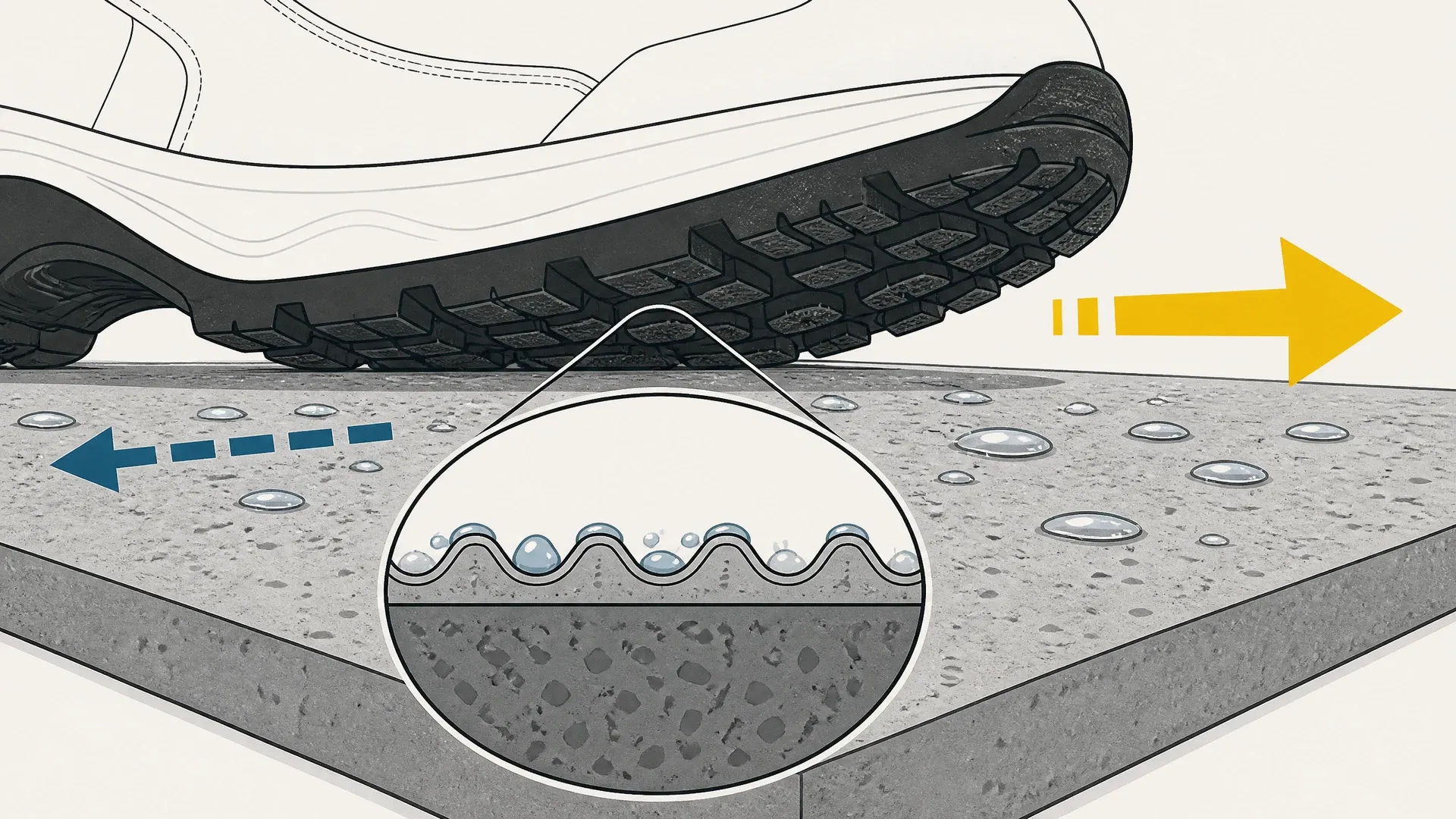
Slip resistance is not a property a floor either has or lacks. It is a result of the surface, the contaminant, the footwear and the way the floor is cleaned. A tile that performs well in a dry showroom can be poor at a kitchen pass with grease on the floor, and a deeply profiled rubber sheet that grips in wet conditions can be difficult to clean well enough to keep gripping. Manufacturers describe performance with several different tests, and the results are not interchangeable. This guide explains what each test measures, where each rating is normally specified, and how to turn the rating into a workable specification.
Four tests, four different questions
The test name matters more than the number. Each method uses a different contaminant, footwear and speed, so a result from one cannot be dropped into another.
Pendulum test and PTV
A spring-loaded arm with a rubber slider swings across the floor. Friction slows the swing, and the loss is converted into a pendulum test value, or PTV. The test can be run dry or wet, on a sample or in situ, and it is the method the Health and Safety Executive uses in its guidance on pedestrian slip risk. Because it can be repeated on an installed floor, it is useful for checking a site after cleaning or after a change of surface treatment. The result depends on the slider condition and the contaminant, so wet and dry figures should be recorded separately. The HSE guidance sets out how the result is used.
Ramp test and R ratings
The DIN 51130 ramp test uses a person in safety footwear walking up a ramp coated with oil. The angle at which grip fails places the floor in a group from R9 to R13. R9 is the least demanding group and R13 the most. This is a shoe test with an oily contaminant, aimed at industrial and commercial kitchens, workshops and food preparation. It says nothing about barefoot areas, and it does not produce a friction coefficient you can compare with a pendulum or DCOF result. The test is published by DIN.
Barefoot wet areas and A/B/C
The DIN 51097 ramp test is run barefoot with water and a soap solution. Results fall into classes A, B and C, from lower to higher slip resistance, and the method is intended for showers, changing rooms, pool surrounds and similar wet barefoot areas. A floor rated R11 for a kitchen is not automatically suitable for a poolside, because the test conditions and the user are different.
DCOF and ANSI A326.3
The American approach measures dynamic coefficient of friction with a portable tester and reports the result against use conditions: interior dry, interior wet and exterior wet. ANSI A326.3 is the current method. It replaced the older practice of quoting a single static coefficient from ASTM D2047, a test developed around polish-coated surfaces and dry conditions, published by ASTM. A DCOF result is only meaningful when the use condition is stated with it.
Why one floor can pass one test and fail another
The tests do not disagree; they measure different situations. A smooth porcelain tile can have a high dry DCOF and a modest wet result, because water sits on the surface and the foot never reaches the texture. A profiled rubber floor can score well on an oiled ramp and still be slippery if the profile fills with grease and is cleaned with the wrong chemical. A floor with a good PTV at handover can lose grip after a few months of detergent residue.
Gait matters too. A ramp test uses a controlled step at a steady speed; a real customer turns, stops, carries a box or wears smooth soles. Test methods also use new samples. An installed floor has wear, polish, dust, food debris and cleaning film. Treat every result as a statement about a specific set of conditions, not a general guarantee.
Contamination, matting and cleaning
Slip problems are contamination problems before they are tile problems. Water at an entrance, grease around a fryer, flour on a bakery floor, milk in a dairy, cleaning chemical left to dry, wax or polish on a floor that was never intended to take it. The surface can only do so much once the contaminant is between the foot and the tile.
Matting carries more of the slip risk than its line in the specification suggests. An entrance mat that is too short, or missing, delivers rain and grit onto the finished floor within a few steps. A matting well that fills with water becomes a slip hazard of its own. Inside kitchens, floor falls and drainage determine whether water stays where it should, and sealed joints stop it reaching the subfloor.
Cleaning is part of the slip system. Over-dosed detergent leaves a film; the wrong degreaser can attack a coating; a polish applied to a safety floor can fill the texture that provides grip. Write the cleaning method into the handover pack and audit it, rather than assuming the contractor will read the label. The maintenance schedules guide sets out how to build that routine.
Where each rating normally belongs
Use this table as a starting point for a schedule, then confirm the requirement with the manufacturer and the authority having jurisdiction.
| Area | Test and class normally specified | Questions to ask |
|---|---|---|
| Commercial kitchen, fryer and dishwash area | DIN 51130, R11 or R12 | Does the profile clean down, and are joints sealed with coving? |
| Restaurant dining area | Pendulum wet PTV or ANSI A326.3 interior wet | What is the wet result, and how are spills handled? |
| Entrance lobby | Pendulum wet and dry PTV, plus matting | How long is the matting run, and who maintains it? |
| Staff washroom and toilet | ANSI A326.3 interior wet | Is the area barefoot or shod in normal use? |
| Shower and changing room | DIN 51097 class A or B | Does the floor slope to the drain, and are level changes detailed? |
| Pool surround | DIN 51097 class B or C | Is the area barefoot, and how is standing water controlled? |
| Retail sales floor | Pendulum dry PTV or ANSI A326.3 interior dry | Which cleaning chemical and polish are specified? |
| External steps and ramps | DIN 51130 R11 or R12, or exterior wet DCOF | How are rain, frost and drainage handled? |
The table is deliberately about test and condition, not a single number. Two products can both meet an R11 requirement and still behave differently after a year of cleaning.
Transitions deserve the same attention as the main field. A threshold strip, a lift sill or a change from tile to carpet is where feet land differently and where water collects. Detail these junctions in the schedule, and check that slip performance does not drop at the point where people turn or step.
From lab number to real-world risk
A laboratory result is measured on a clean sample, with a calibrated device and a trained operator. The same floor in a building is affected by wear, contamination, cleaning, temperature, slope, lighting and the behaviour of the people on it. That gap is why a test certificate is not a risk assessment.
Local building regulations, fire and safety rules, and insurers may set their own requirements, and they can differ by jurisdiction and by building use. Confirm the requirement with the authority having jurisdiction before the specification is fixed, and keep the correspondence with the project file. Where a client or insurer asks for a specific class, ask which test and which condition they mean.
Record the test method, the condition and the date in the operation and maintenance manual. Retest at handover, after a deep clean or a change of chemical, after any coating or refurbishment, and after an incident. A result without a date and a method is not useful evidence.
When you compare two quotes, compare the test and the condition as well as the class. A supplier who quotes an R rating for a canteen servery has answered a different question from one who quotes a wet PTV for the same area. Ask for the result on the same test, at the same condition, on the same construction. If one bidder cannot supply the figure, the prices are not comparable, however similar the headline class appears.
Slip is only one part of a floor schedule. AC ratings for high-traffic floors explains how abrasion classes sit alongside it, and commercial flooring types covers construction choices for kitchens and sales floors.
What to do next
- List every area by contaminant and footwear: dry shoes, wet shoes, barefoot, grease, flour, outdoor.
- Ask for the test method and the condition, not just a class, then check how the ratings fit together in durability ratings explained.
- Inspect the entrance matting, drainage and cleaning chemicals before blaming the tile.
- Write the cleaning method into the handover pack and the cleaning contract.
- Confirm any statutory or insurer requirement with the authority having jurisdiction, and record the response.
- For kitchens and dining rooms, read flooring for a restaurant kitchen before the specification is issued.
If you are reviewing a schedule or a set of quotes and the slip results do not line up, request a consultation and we will check each area against the test it actually needs.