
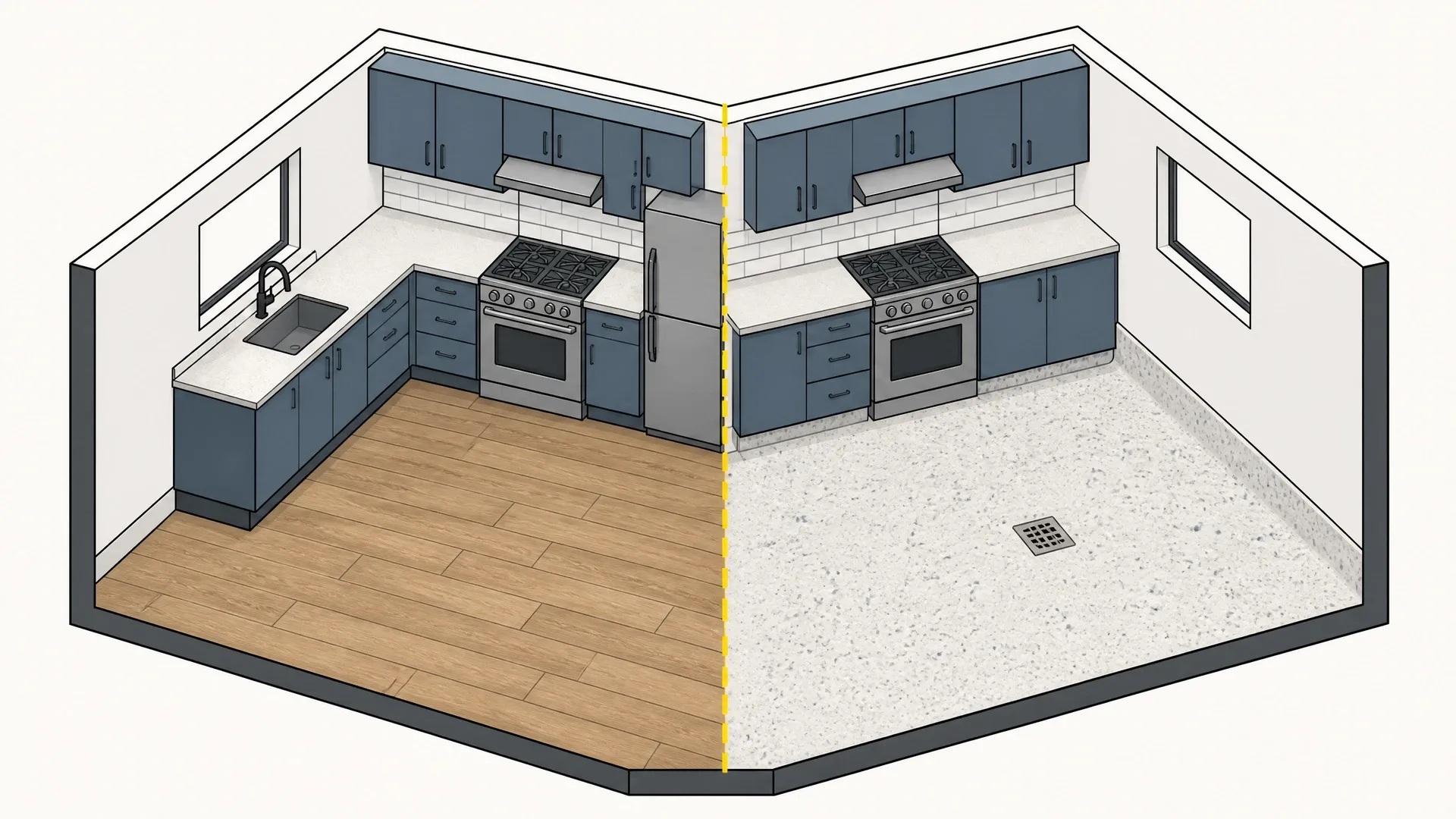
A unit goes empty, the inspection finds the vinyl worn through at the entrance and lifting at the bathroom door, and the floor has to be replaced before the next tenancy. The choice usually comes down to rigid-core luxury vinyl plank, sold as click-lock planks, or sheet vinyl, sold in rolls and cut to the room. Both are resilient vinyl over the same subfloor. They differ in how many joints they have, how they fail and how much floor has to be replaced when they do. The decision process below works unit by unit, so one building does not end up with three different answers.
The two products in plain terms
Rigid-core LVP
Rigid-core plank is a sandwich. A clear wear layer sits over a printed decor film, which sits on a rigid core, usually a stone-polymer or wood-polymer composite, with a backing layer beneath. Planks are usually click-locked into a floating floor. Every plank edge is a joint, so an average room has hundreds of them, but a floating floor can be opened up and a single damaged plank swapped out.
Sheet vinyl
Sheet vinyl is a continuous roll, cut to the room and usually glued down. Domestic grades carry a felt or foam backing; commercial grades are denser and often homogeneous, with the pattern running through the thickness. Joints are few, and seams between rolls can be heat-welded into a continuous surface. Sheet can also be coved up the wall and finished with a cap strip, which removes the floor-to-wall junction as a water path.
Where each one wins
Plank wins on appearance and repair logistics. A plank layout reads as timber or tile, hides scuffs better than a uniform sheet, and a spare carton in the cupboard turns a damaged board into a short maintenance job rather than a re-floor. The look also matters at letting: a wood-effect plank photographs well and reads as an upgrade in a listing.
Sheet wins on water and on joints. A welded seam is continuous, a coved edge has nowhere for water to pool, and there are far fewer places for liquid to reach the subfloor. In bathrooms, kitchens and utility rooms, that difference decides the specification more often than appearance does. Sheet is also quicker to clean, because there is no grid of joint lines collecting dirt.
| Specification point | Rigid-core LVP | Sheet vinyl |
|---|---|---|
| Joints | One at every plank edge | One per roll width, heat-welded |
| Water at the joint line | Liquid can track under a floating floor | Welded seam keeps the surface continuous |
| Single-point repair | Plank lifted and replaced from spare stock | Patch cut in and re-welded by a specialist |
| Appearance | Plank and tile formats, wide decor range | Printed all-over patterns, fewer formats |
| Subfloor tolerance | Bridges small hollows, rocks over high spots | Telegraphs every ridge and grout line |
| Acclimation | Planks conditioned in the room before fitting | Roll unrolled and relaxed, then glued |
| Downtime | Floating floor walkable on completion | Adhesive needs to set before heavy traffic |
| Rooms it suits best | Bedrooms, living areas, home offices | Kitchens, bathrooms, laundries, utility rooms |
Subfloor and moisture come first
Neither product fixes a bad substrate. Sheet vinyl is the less forgiving of the two: flexible vinyl takes the shape of whatever is underneath, so a ridge in the screed, a proud tile edge or a line of old adhesive shows through within weeks. Rigid core spans small hollows, which is why it is sold as a remedy for imperfect floors, but it cannot span a high spot. A plank that rocks on a lump flexes at the joint every time it is walked on, and click joints fail by fatigue rather than by wear.
Flatness should be measured with a straightedge in more than one direction, not judged by eye. Moisture matters just as much, particularly in ground-floor and below-ground units, and in any building where the slab was laid without a damp-proof membrane. Test before you buy, using an in-situ relative humidity probe or a calcium chloride test as appropriate to the slab, and follow the manufacturer’s stated limits rather than a rule of thumb. A floating plank floor over a slab usually needs a vapour barrier with a stated permeability; a glued sheet needs an adhesive system approved for the moisture level found. If the test result is marginal, the floor type is not the problem to solve first.
Existing hard floors complicate the decision. Sheet can sometimes go over sound, well-bonded tile or vinyl once grout lines are filled and the adhesive system is confirmed as suitable. Adding a layer also raises the floor at every doorway, appliance recess and threshold, which is a joinery problem as much as a flooring one.
Wear layer and use class
The wear layer is the clear vinyl above the printed design, and it is the part that takes the grit. It is quoted in mil; one mil is 0.0254 mm, so a figure in thousandths of an inch converts to a small fraction of a millimetre. Thicker wear layers last longer under the same traffic, but thickness alone is not quality: print film, core stiffness and joint design all affect how the floor behaves.
Use class is the better guide to suitability. ISO 10874 sorts resilient floors by traffic type and intensity, from domestic classes through commercial classes to light industrial, and the class is stated by the manufacturer. A plank rated for domestic use in a spare bedroom is not the right product for a shared entrance hall, and using it there generally falls outside the warranty. The classes are explained in more detail in the guide to durability ratings.
One frequent mix-up: the AC abrasion classes printed on laminate packaging do not apply to vinyl. LVP and sheet vinyl are compared on wear layer, use class and construction, not on AC ratings. If a supplier quotes an AC number for a vinyl plank, ask what it is meant to represent.
Seams, repairs and the handover pack
Seams and welds
A sheet installation is only as good as its seams. In wet areas the seam should be heat-welded, not cold-seamed: a weld fuses two edges into one surface, while a cold seam can fail quietly under a washing machine. Coved skirting finishes the perimeter properly. On plank, the weak points are the plank ends near a bath, shower or external door, where water sits on the surface. A common compromise is welded sheet in the wet rooms and plank everywhere else, with a transition strip at the door.
Repairs and spare stock
Keep spare material from the same production run: colour and pattern vary between runs, and a mismatched plank in the middle of a room is more visible than a worn floor. Store cartons flat and dry, off a concrete slab, and record where they are. A floating click plank can be replaced by unclipping the run back to the damaged board; a glued plank has to be cut out and patched. Sheet repairs need an offcut of the original roll, a neat cut-out and a new weld.
Acclimation, install time and underlayment
Plank should be conditioned in the room at normal occupied temperature before fitting, and click floors need expansion gaps at the perimeter and at doorways. Underlayment is where specifications go wrong: some planks have a pad attached and must not have another one added, because a separate pad lets the joints flex. Follow the manufacturer’s list. Sheet needs a smooth substrate, often a smoothing compound, then adhesive with a stated open time, rolling, and weld rods trimmed back after cooling.
Cleaning instructions to hand over
Give the tenant a single page, not a verbal briefing. Dry-mop or vacuum grit before washing, use a pH-neutral cleaner at the dilution on the bottle, and never flood a floor or leave water standing at a seam. Most manufacturers advise against steam mops on plank, because heat and moisture attack the joint and the adhesive. Felt pads under furniture legs and a mat at the entrance reduce the grit that does the actual damage. Rubber-backed mats can stain vinyl, so specify a mat with a backing the manufacturer accepts. Ask tenants to report lifting planks rather than gluing them down themselves.
If you only remember three things
Wet rooms go sheet, welded and coved, unless you have a specific reason otherwise. The subfloor flatness and moisture reading decide whether either product can be fitted properly, so test before ordering. And buy spare stock with the original order, because the repair you can do from a cupboard is the one that keeps a unit lettable.
What to do next
Survey the unit room by room and write down floor area, substrate, moisture reading and which rooms are wet. The rental unit flooring guide sets out how that split usually falls, and the durability guide explains how to read the use class on a sample. Then put the replacement into the capital plan using the ten-year replacement budget method, so the next turnover is funded rather than improvised. If the substrate is unknown or the moisture result is borderline, request a consultation before any material is ordered.